SMC Pneumatic Components FAQ: 6 Questions Every Procurement Engineer Asks
2026-05-09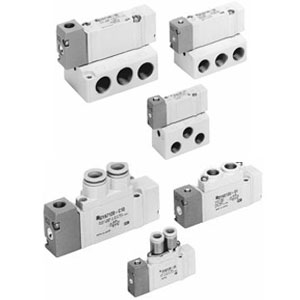
After years of working with procurement and engineering teams, certain questions about SMC pneumatic components come up repeatedly. Here are the six most common, each drawn from real project experience.
Q1: What do the letters and numbers in an SMC part number mean?
Take SY5120-5LOU-01F-Q as an example. SMC part numbers follow a systematic structure: series code + valve function + coil voltage + port specification + option suffixes.
– SY: Series identifier (base code for SY3000/SY5000/SY7000)
– 5: Valve function (5 = 5-port 2-position, 4 = 4-port, 3 = 3-port)
– 120: Port/flow class code
– 5LOU: Coil specification and voltage code
– 01F: Port type (F = G thread, N = NPT, push-in fittings use different codes)
– -Q: Option suffix (-Q = copper-free specification for semiconductor applications)
The coding logic is consistent across series, but always verify details against the specific product catalog. SMC’s official website provides an online configurator that generates complete order codes from input parameters.
Q2: Are SMC and FESTO interchangeable? Do mounting holes match?
The answer varies by product type:
Cylinders: Series conforming to the same ISO standard are interchangeable. Under ISO 15552, SMC CP96 and FESTO DSBC share identical mounting footprints. Under ISO 21287, SMC CQ2 and FESTO ADN are interchangeable. Under ISO 6432, SMC CM2/CG and FESTO DSNU are compatible for most bore sizes, but a few variants have port position differences — verify per model.
Solenoid valves: Generally not interchangeable. SMC SY series and FESTO VUVS series use different manifold interfaces. Brand substitution typically means replacing the entire valve assembly and manifold, not individual valves.
Air preparation: Partially interchangeable, but full FRL stack replacement is recommended. Port threads match (G1/4, G3/8, etc.), but seal designs and filtration standards differ between brands.
Q3: What is SMC’s C-value and how do I calculate flow from it?
C-value is SMC’s flow characteristic parameter, unit dm3/(s*bar). It describes flow capacity under standard conditions. Formula: Q = C * sqrt(P1 – P2), where P1 is inlet pressure (bar) and P2 is outlet pressure (bar).
Example: an SY5000 5-port valve with C-value 0.93. At 5 bar inlet and 1 bar pressure drop, actual flow = 0.93 * sqrt(1) = 0.93 dm3/s, approximately 55.8 L/min.
Note: FESTO uses the international Kv value (m3/h). Approximate conversion: C is approx. Kv * 16.7. Don’t confuse the two when cross-referencing.
Q4: My solenoid coil burned out. Is this a manufacturing defect?
Based on our service data, roughly 60% of coil failures are not intrinsic coil defects but external factors:
– Voltage fluctuation: A DC24V coil running continuously at plus/minus 10% rated voltage sees accelerated thermal aging. In field measurements, sustained 28V supply raises coil surface temperature by approximately 18C versus 24V.
– Back EMF: In control circuits without flyback diodes, the reverse voltage spike at switch-off can reach 3-5x rated voltage, causing cumulative insulation damage. SMC genuine coils include built-in surge suppression; third-party replacements may not.
– Ambient temperature: Valve manifolds mounted in sealed control cabinets can see summer interior temperatures exceeding 50C. Coil rated life is defined at 25C ambient; every 10C increase roughly halves insulation life.
A quick diagnostic: a single burned coil is likely a quality issue. The same position burning coils repeatedly is almost certainly an application issue.
Q5: My cylinder isn’t producing enough force. What should I check?
Cylinder theoretical force: F = P * A (P = supply pressure, A = effective piston area). If measured force is below theoretical, troubleshoot in this order:
1. Measure actual supply pressure at the cylinder inlet port — not at the compressor or main line. After FRL, tubing, and fittings, a 0.1 MPa drop is normal.
2. Check speed control valves. Overly restricted flow raises back pressure, counteracting forward force.
3. Check load ratio. Standard recommendation: maximum 70% load ratio for static loads, 50% for dynamic. If already near the limit, the only fix is a larger bore.
4. Check mounting alignment. Misalignment between the piston rod and load path wastes force through side load friction. Use a dial indicator if visual inspection isn’t conclusive.
Q6: Which is better — SMC or FESTO?
There’s no universal answer, but here’s a practical framework:
– Lead time: SMC has deeper inventory and broader channel coverage in China, with higher in-stock rates on common part numbers.
– System integration: If your architecture centers on bus-coupled valve manifolds, FESTO’s CPX/CPX-AP-A platform covers a wider protocol range (PROFINET, EtherCAT, EtherNet/IP, IO-Link all supported). SMC EX600 supports multi-protocol but lags slightly on IO-Link device compatibility.
– Reliability: Both brands are highly reliable within their rated operating windows. Real-world differentiation comes down to local service responsiveness and spare parts availability rather than product quality.
– Price: At equivalent annual volumes, standard model pricing is comparable. Differences emerge in custom solutions and system-level quotation strategies.
In practice, most factories use both SMC and FESTO. As long as the product is standardized, correctly specified, and properly matched to operating conditions, neither brand will let you down.
These six questions address the most common selection and application inquiries. For specific product requirements or technical consultation, contact our engineering team directly.