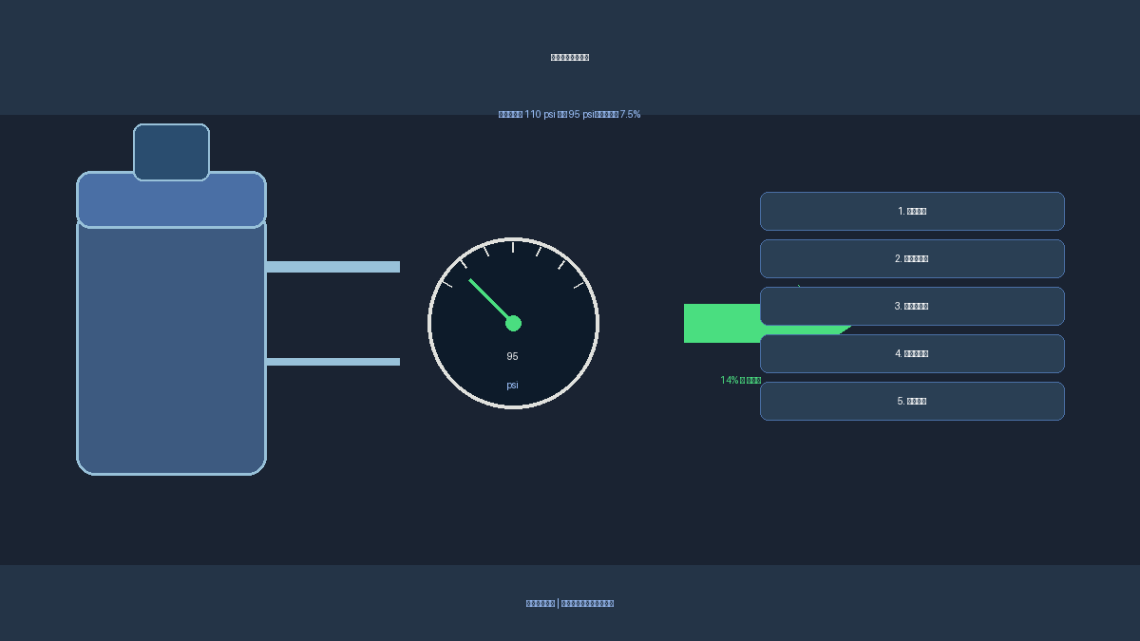
Five Low-Cost Steps to Cut Compressor Energy: Drop System Pressure from 110 to 95 psi | Doskee Automation
2026-07-17Five Low-Cost Steps to Cut Compressor Energy: Drop System Pressure from 110 to 95 psi
Compressed air is one of manufacturing’s largest energy expenses — and most plants run it far above what their machines actually require. The problem isn’t that you bought the wrong compressor. The problem is you’re paying for demand that doesn’t exist.
This article walks through a five-step methodology developed by Steve Bain, Industry Segment Manager for Food and Packaging at Festo. No new compressors. No capital expenditure. Just systematic, machine-level analysis to uncover what your machines actually need — and how much you can save by giving them exactly that.
We’ll use a representative five-machine production line — filler, capper, cartoner, case packer, and palletizer — to illustrate each step.
The Reality in Most Plants: Why Is Your Pressure So High?
Most compressor pressure settings are historical artifacts. At some point, pressure was raised to solve an immediate production issue — and it was never brought back down. Without an accurate record of what pressure each machine requires, the higher setpoint stays indefinitely.
Meanwhile, leakage and unintended air use are silently raising the system baseline. A fitting vibrating loose, a seal wearing out, a cabinet cooler left running — each is insignificant alone, but together they force the compressor to work harder than the processes truly demand.
And here is the key insight: every plant has a “limiting machine” — the highest air consumer on the line. Until this machine is identified and addressed, it effectively holds the entire compressed air system hostage. No amount of tuning elsewhere will let you lower the compressor setpoint.
Step 1: Eliminate Leaks and Unintended Air Use
Leaks are the quietest energy thieves in the plant. They don’t just waste air — they continuously raise the baseline pressure the compressor must maintain, increasing energy cost before any machine even begins its cycle.
Losses fall into two categories:
- Passive leaks: Worn seals, loose fittings, aging piping, damaged tubing
- “Designed leaks”: Vacuum generators running during stoppages, cabinet coolers without thermostats, blow-off air that never shuts off
On the filler in our example line: a conveyor-side fitting was leaking steadily. It was audible with an ultrasonic acoustic wand and immediately confirmed with an acoustic imaging tool. Fixing this single leak reduced the filler’s baseline air draw, creating headroom to lower its operating pressure in the next step.
Every leak you fix reduces the constant load on the compressor, improves system stability, and creates the margin needed to safely lower pressure.
Step 2: Establish the True Minimum Pressure for Each Machine
Machines are commissioned with regulators set slightly above their required pressure for a margin of safety. As the machine ages, seals and fittings wear, and operators respond to slower or inconsistent motion by turning up the regulator. Over time, this creates an upward creep that makes the machine appear to need more pressure than it truly requires.
The method for finding true minimum pressure is simple and costs nothing:
- A maintenance technician gradually turns down the regulator while the machine runs at normal cycle rate
- Continue reducing until the machine begins to show inadequate motion — an axis that fails to reach position, a gripper that loses grip, a cylinder that stalls
- Raise the pressure slightly to establish a stable buffer, and record the new setpoint
- Test each axis, gripper, cylinder, or vacuum device individually under normal cycle conditions
On the cartoner in our example line: the technician ran this pressure test and confirmed the cartoner operates reliably at 76 psi — down from its historical setting of 80 psi. Four psi saved, no parts required.
Step 3: Identify Peak-Demand Events and the Limiting Machine
Lowering steady-state machine pressure reduces overall consumption, but it doesn’t reveal which machine creates short-burst, high-flow events that momentarily pull down system pressure. These peak events are critical because the compressor must be set high enough to prevent a pressure sag during the heaviest motion on the line.
Typical peak-demand triggers: a large-bore cylinder moving a heavy load, multiple actuators firing simultaneously, a vacuum circuit releasing high volume in a single vent cycle.
The simplest fix: add a small reserve tank (air receiver) near the component creating the momentary drop. The tank acts as a local buffer, supplying the burst of air that the peak event demands without pulling down the entire system. Low cost, often immediate results.
On the cartoner: placing a reserve tank close to its large-bore lift cylinder supplies the burst for that motion while buffering the rest of the machine pressure.
With peak events neutralized, the machine with the highest validated pressure requirement emerges as the limiting machine — the one that ultimately prevents further reduction of the compressor setpoint. In our example, the palletizer’s large-bore cylinders consume high air volume on every cycle. That steady requirement, not a momentary peak, makes it the bottleneck.
Step 4: Reduce Demand at the Limiting Machine
Why does the limiting machine use so much air? Three common root causes:
- Oversized cylinders: Design engineers spec larger bores than needed to guarantee performance — and every extra millimeter of diameter is extra air consumed on every stroke
- Long tubing runs and restrictive fittings: Convenient routing and quick-disconnect fittings that choke flow — both increase pressure drop and waste air volume
- Pneumatic motion where electric would be better: High-force, long-stroke, sustained-load applications are often far more efficient with electric servo axes
On the palletizer: its lift function was originally driven by a large-bore pneumatic cylinder. Converting this single motion to an electric servo axis eliminated the cylinder’s high air demand entirely. The palletizer was no longer the limiting machine.
Now the cartoner became the new limiting machine. Maintenance performed two targeted adjustments — shortening an unnecessarily long tubing run and replacing a restrictive fitting — and the cartoner’s validated pressure dropped as well.
These are not machine rebuilds. They are targeted surgical corrections. Each change directly reduces the volume of compressed air consumed per cycle.
Step 5: Monitor the System to Sustain the Gains
The savings you capture can be quietly erased by pressure creep if you don’t lock them in:
- Record each machine’s validated pressure on a regular schedule
- Treat any unexplained upward pressure adjustment as a signal that a component needs inspection
- Install low-cost red/green zone pressure gauges on every machine regulator — green indicates the pressure is at the validated setpoint, red signals someone has turned it up
Red/green gauges are a simple but powerful visual management tool. Operators and maintenance personnel recognize deviations immediately, and corrective action happens in the moment — not weeks later when the electric bill arrives.
The Bottom Line: What Five Steps Delivered
| Phase | Compressor Setpoint | Change |
|---|---|---|
| Starting point | 110 psi | — |
| After leak fixes + pressure validation | 99 psi | -10% |
| After peak reduction + limiting machine fixes | 95 psi | Additional -4% |
| Total | 110 → 95 psi | -14% air consumption, -7.5% energy |
Per U.S. Department of Energy guidelines, every 2 psi reduction in system pressure yields approximately 1% energy savings at the compressor. Going from 110 to 95 psi — a 14% reduction in pressure — translates to roughly 7.5% lower compressor energy consumption. No new equipment. No production downtime. No capital expenditure.
And as a bonus: operating the system at lower, validated pressures extends the service life of the existing compressor, potentially delaying or eliminating the need for a replacement unit. The carbon footprint improvement is a meaningful sustainability contribution as well.
Doskee Automation specializes in industrial automation and fluid control, offering FESTO, SMC, and other leading-brand air preparation systems, energy-efficient valve terminals, flow and pressure sensors, and compressed air piping products. We help clients evaluate compressed air system efficiency and implement low-cost energy-saving measures at the machine and system level. For technical consultation, please contact us.
References: PneumaticTips “Lower compressor energy consumption with low-cost machine adjustments” by Steve Bain, Industry Segment Manager, Food and Packaging, Festo | U.S. DOE Compressed Air System Best Practices Guide