ISO 6432 Cylinder Cross Reference: Festo DSNU vs SMC C85 vs Norgren RM/8000
2026-10-31If you are replacing a Festo DSNU with an SMC C85 or a Norgren RM/8000 (or the other way round), the standard on the datasheet, ISO 6432, is a useful starting point but not the whole answer. This guide shows what the standard really fixes and how each brand’s part number is built. It also gives you a short checklist so the new cylinder fits, senses and cushions like the old one. Every figure below comes from the manufacturer’s own catalogue, and the source is named next to each table.
The short answer: what ISO 6432 covers and what it doesn’t
ISO 6432 fixes the basic and mounting dimensions of small single-rod cylinders with 8–25 mm bores and a 10 bar (1 000 kPa) rating. It does not make part numbers equal. Two ISO 6432 cylinders with the same bore and stroke will usually bolt into the same space. Cushioning, magnet, sensor rail, seals, temperature range and accessories are still each maker’s own design. ISO says this itself: the standard sets mounting dimensions for interchangeability, and manufacturers keep their freedom of design (ISO 6432:2015, iso.org).
| What ISO 6432 standardises | What it leaves to the manufacturer |
|---|---|
| Bore series 8, 10, 12, 16, 20, 25 mm | Part-number structure and suffix meaning |
| Basic and mounting dimensions for interchangeability | Whether a magnet is fitted, and which sensors fit |
| A 10 bar (1 000 kPa) series | Cushioning type (elastic pads or adjustable air cushion) |
| Single-rod cylinder family | Seal materials, temperature range, minimum pressure, available strokes |
| — | Accessories (rod eyes, foot and flange brackets, sensor brackets), spare parts and repairability |
One practical point: ISO 6432 stops at 25 mm. A 32 mm or 40 mm “round cylinder” is outside the standard. That matters below.
Series map: Festo, SMC and Norgren
Festo: DSNU, DSNU-S, ESNU
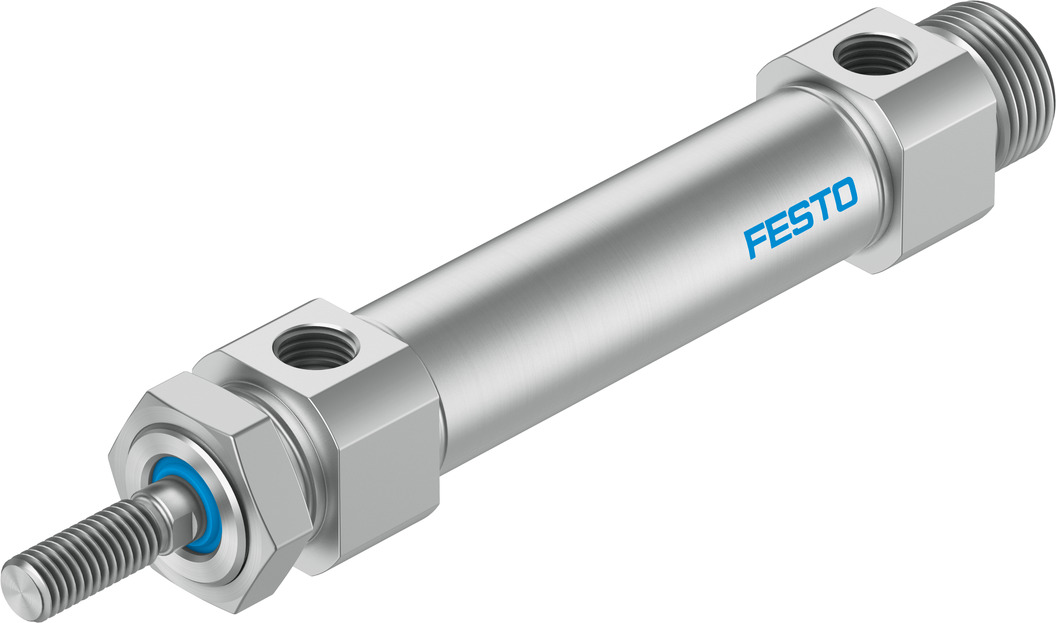
Festo’s catalogue Standard cylinders DSNU/DSNUP/DSN/ESNU/ESN, ISO 6432 states that round cylinders with piston diameters from 8 to 25 mm conform to ISO 6432. DSNU (and DSN) are double-acting; ESNU (and ESN) are single-acting. The 32–63 mm DSNU sizes are in a separate “Round cylinder” catalogue and are not covered by the ISO 6432 statement. The same catalogue notes that the series is not designed for repair (Festo DSNU-ISO catalogue, PDF). Background on the series: Festo DSNU round cylinder, Festo ESNU single-acting round cylinder, and the Festo standard cylinder selection guide (DSBC vs DSNU vs ADN vs DSBG).
SMC: C85 / CD85, single-acting C85…S/T, non-rotating C85K
In SMC’s ISO Cylinder C85/C75 Series catalogue, the ISO 6432 series is C85, for ø8 to ø25. The standard, non-rotating (C85K) and direct-mount versions are all marked ISO 6432. The 32 and 40 mm C75 is not marked as an ISO series (SMC C85/C75 catalogue, PDF). “CD85” simply means a C85 with a built-in magnet. Single-acting versions use S (spring return) or T (spring extend) in the code. SMC’s compact round cylinders CJ2 and CM2 are separate series. CJ2 comes in ø6/10/16 with a 0.7 MPa maximum operating pressure. CM2 covers ø20–40. SMC does not list either one as its ISO 6432 series (SMC CJ2 catalogue, SMC CM2 catalogue). For worked examples of C85 part numbers, see CD85N16-80C-A explained and CD85F20-40-B explained.
Norgren: RM/8000/M, RM/28000/M, TRM/8000
IMI Norgren’s RM/8000/M is a double-acting ISO 6432 cylinder in 10–25 mm bores. There is no 8 mm size, and a magnetic piston is standard (IMI Norgren datasheet en 1.5.021 RM/8000/M). RM/28000/M is the single-acting (sprung-in) version, 10–25 mm, with strokes up to 50 mm (IMI Norgren datasheet en 1.4.031 RM/28000/M). The RM/8000 datasheet lists TRM/8000 as a non-magnetic, high-temperature variant (16–25 mm). Norgren’s RT/57100/M “Roundline” single-acting cylinder is a different design. Its datasheet describes it as shorter than a corresponding ISO/VDMA cylinder and does not call it ISO 6432, so don’t treat it as an RM/28000 equivalent.
Other makers
Other manufacturers sell round mini cylinders described as ISO 6432 (series often quoted include Parker P1A, Camozzi 16/24/25 and AirTAC MI). We have not checked those catalogues for this article, so apply the same checklist and confirm each suffix in the maker’s current catalogue.
Part-number suffixes side by side
The codes below follow each maker’s current ordering key. They are a reading aid, not a conversion table: one suffix rarely maps exactly to another.
| Feature | Festo DSNU / ESNU | SMC C85 | Norgren RM/8000/M |
|---|---|---|---|
| Example code | DSNU-25-80-PPV-A | CD85N20-40C-B | RM/8025/M/50 |
| Action | DSNU double; ESNU single | Double; S = spring return, T = spring extend | RM/8000 double; RM/28000 single (sprung in) |
| Bore range (ISO 6432) | 8–25 mm | 8–25 mm | 10–25 mm (no 8 mm) |
| Magnet for sensing | -A = position sensing | D in “CD85” = built-in magnet; no D = none | /M = magnetic piston, standard |
| Cushioning | P = elastic rings/pads both ends; PPV = adjustable pneumatic (not on 8/10 mm); PPS = self-adjusting (from 16 mm) | Nil = rubber bumper; C = air cushion (not ø8, N head cover only) | Buffer on all bores; adjustable cushioning uses bore codes 17/21/26 (for 16/20/25 mm) |
| Cover / mounting style | Variants such as MQ (lateral port), MA (axial port), MH (direct mounting); brackets ordered separately | Head cover N/E/F/Y; bracket letter L, M, G, U or N in the code | Variants MC (central rear port), MF (flat rear cover); mountings ordered separately |
| Rod options | Q = square rod (anti-rotation, 12–25 mm); K-options for rod ends; S2 = through rod | C85K = non-rotating; V/W = rod-end accessory included | N2 = non-rotating (12–25 mm); MU = extended rod; JM = double rod |
| Sensor mounting | Festo proximity sensors and mounting kits | -A = rail, -B = band, followed by switch model (e.g. M9BW) | QM/33 switch brackets with M/50 switches |
Sources: Festo DSNU-ISO catalogue; SMC C85/C75 catalogue; IMI Norgren en 1.5.021.
Common ISO data at the ISO bores
Ports and rod threads line up across the three brands at each bore, which is why ISO 6432 swaps are usually easy on the mechanical side. Pressure and temperature ranges differ.
| Bore | Port (Festo / SMC / Norgren) | Piston-rod thread |
|---|---|---|
| 8 mm | M5 / M5x0.8 / not offered | M4 |
| 10 mm | M5 / M5x0.8 / M5 | M4 |
| 12 mm | M5 / M5x0.8 / M5 | M6 |
| 16 mm | M5 / M5x0.8 / M5 | M6 |
| 20 mm | G1/8 / G1/8 / G1/8 | M8 |
| 25 mm | G1/8 / G1/8 / G1/8 | M10x1.25 |
| Condition | Festo DSNU (ISO) | SMC C85 | Norgren RM/8000/M |
|---|---|---|---|
| Operating pressure | 1.5–10 bar (8–12 mm); 1–10 bar (16–25 mm) | Max 1.0 MPa; min 0.05–0.1 MPa depending on bore (rubber bumper) | 1–10 bar |
| Ambient temperature | −20 to +80 °C (S6 heat-resistant variant 0 to +120 °C) | −20 to 80 °C without switch; −10 to 60 °C with switch | −5 to +80 °C |
Sources: same catalogues as above. Sensor temperature limits apply in addition to the cylinder’s own range.
Look-alikes that are not a match
- DSNU-32 or DSNU-40 “to SMC/Norgren ISO 6432”: 32 mm is outside ISO 6432. Festo puts 32–63 mm DSNU in a separate catalogue, SMC’s 32/40 mm round cylinder is C75 (not marked ISO), and RM/8000 stops at 25 mm. Compare drawings, not the standard.
- DSNU-16-50-P-A vs. CD85N16-50-B: both are 16 mm, 50 mm stroke and magnetic, but P (elastic pads) and SMC’s rubber bumper are different designs. In SMC’s current code, “-B” means band-mounted switch, not a cushion type. The N head cover also sets the rear mounting. Lists that state “DSNU-16-50-P-A = CD85N16-50-B” skip all of this.
- RM/8016/M vs. RM/8017/M: same 16 mm bore, but 17 is the adjustable-cushion version. Copying only the bore digits loses the cushioning.
8-point checklist before you order
- 1. Action: double-acting or single-acting, and for single-acting whether the spring retracts or extends the rod.
- 2. Mounting: nose thread with nut, rear clevis or eye, foot, flange or trunnion. Check the rear cover style in the code and which brackets you have to order separately.
- 3. Rod end: thread size (see table), male or female, rod-eye or clevis accessory, anti-rotation if the tool must not turn.
- 4. Body length: compare the retracted length and stroke on both drawings. Same stroke does not guarantee the same overall length.
- 5. Ports: size (M5 or G1/8) and position (radial, axial or rear).
- 6. Sensor: magnet present? Which switch and bracket? Is there enough stroke for sensing? (Festo states a 10 mm minimum stroke for sensing on this series.)
- 7. Cushioning: pads/bumper or adjustable air cushion, matched to the moving mass and speed. SMC publishes allowable kinetic energy per bore in the C85 catalogue.
- 8. Operating conditions: minimum and maximum pressure, temperature with and without sensors, air quality, and any washdown or corrosion requirement.
Sensors and accessories
Sensors are where most cross-brand swaps go wrong. The cylinder body may fit perfectly while the old switch has nothing to clamp onto.
- Festo: order the “-A” variant for position sensing, then a Festo proximity sensor and the matching mounting kit from the catalogue.
- SMC: the magnet comes with “CD85”. Choose rail (-A) or band (-B) mounting and the switch model. Some combinations are excluded: the C85 catalogue notes, for example, that D-A9 switches cannot be band-mounted on ø8–12 and D-M9 switches cannot be rail-mounted on ø20/25.
- Norgren: /M cylinders have a magnetic piston. Switches (for example M/50 series) fit with QM/33 brackets, and the datasheet lists different brackets for strokes above and below 15 mm. TRM/8000 has no magnet.
Rod eyes, clevis and foot brackets are usually brand-specific part numbers even where the thread is the same. Re-use an existing rod eye only after checking the thread and the length it adds.
When it is not a “drop-in replacement”
- The bore is 32 mm or larger (outside ISO 6432).
- The original had an adjustable air cushion and the replacement only has pads, or the other way round, on a fast or heavily loaded axis.
- The machine uses existing switches or a sensor rail that the new brand cannot take.
- The old cylinder is a special: through rod, heat-resistant, low friction, clamping unit, corrosion-resistant or explosion-protected variant.
- The safety function of the machine depends on the cylinder’s timing or end position.
In these cases treat the change as an equipment modification. Get the drawings approved and re-validate the machine; don’t treat it as a spare-part swap.
Commissioning check after fitting
Safety first: lock out and tag out the machine, shut off and exhaust compressed air from the circuit, and make sure no load can move under gravity before removing the old cylinder.
- Compare installed length and stroke with the old unit; check that end positions are still reached without hitting the tooling.
- Start at low pressure and slow speed; set flow controls and, where fitted, adjustable cushions.
- Confirm each sensor switches at both end positions and that the PLC sees the right input.
- Check for leaks at ports and the rod seal, and for side load on the rod.
- Record the new part number on the machine’s spare-parts list.
RFQ template: what to send us
The fastest way to a correct quote is the original part number or a clear photo of the nameplate. If those aren’t readable, send:
- Brand and full part number of the existing cylinder (or nameplate photo)
- Bore and stroke
- Single- or double-acting
- Mounting style and rod-end type
- Whether sensors are used, and the sensor part number
- Cushioning required
- Operating pressure, temperature and environment
- Quantity
Email it to doskee@dustry.ltd and we’ll reply with a proposed part number for each brand and the points you need to check. Price and delivery are confirmed in a written quotation. You can also browse the Festo, SMC and Norgren categories, or example DSNU listings such as DSNU-16-70-P-A and DSNU-20-70-PPV-A.
FAQ
Are all ISO 6432 cylinders directly interchangeable?
Mechanically they share the mounting dimensions for 8–25 mm bores, so they usually fit the same space. Cushioning, magnet, sensors, accessories and operating limits are not standardised, so check those before calling it a direct replacement.
Which SMC and Norgren series correspond to Festo DSNU?
At 8–25 mm, SMC’s ISO 6432 series is C85 (CD85 with magnet) and Norgren’s is RM/8000/M (10–25 mm). For single-acting ESNU, look at C85 with S/T and Norgren RM/28000/M. Exact suffixes still have to be chosen one by one.
Can I choose a replacement by bore and stroke alone?
No. Bore and stroke get you to the right series. Action, mounting, rod end, ports, sensor, cushioning and operating conditions decide the actual part number.
Will my existing magnetic switches work after a brand change?
Usually not without changes. Each brand uses its own switch and bracket system. Plan on new sensors and brackets from the new cylinder’s maker, and check the switching points on the machine.
What is the difference between SMC CD85 and C85?
The “D” means a built-in magnet for auto switches. C85 has no magnet, so switches cannot detect the piston.
What information do I need for an RFQ?
The original part number or a nameplate photo is best. Otherwise send bore, stroke, action, mounting, rod end, sensor, cushioning, operating conditions and quantity (see the template above).
When does a swap become an equipment change?
When the bore is outside 8–25 mm, the cushioning or sensing concept changes, a special variant is involved, or the cylinder is part of a safety function. Then you need drawing approval and re-validation rather than a simple spare.
Sources
- ISO 6432:2015, Pneumatic fluid power — Single rod cylinders, 1 000 kPa (10 bar) series, bores from 8 mm to 25 mm: iso.org/standard/64054.html
- Festo, Standard cylinders DSNU/DSNUP/DSN/ESNU/ESN, ISO 6432: DSNU-ISO_EN.PDF
- SMC, ISO Cylinder C85/C75 Series: C85_C75.pdf
- SMC, Air Cylinder CJ2 / CM2 Series: CJ2.pdf, CM2.pdf
- IMI Norgren, RM/8000/M datasheet en 1.5.021: en_1_5_021_RM_8000.pdf
- IMI Norgren, RM/28000/M datasheet en 1.4.031: en_1_4_031_RM_28000_M.pdf
Catalogue data can change between editions. Always confirm the final part number against the manufacturer’s current catalogue before ordering.